The short answer: go between July and October to see the herds cross the Mara River in Kenya’s Maasai Mara and Tanzania’s northern Serengeti. Go between late January and March to see calving on the Ndutu plains in the southern Serengeti.
The Great Migration happens all year. More than a million wildebeest, with zebras and gazelles, move in a loop between Tanzania’s Serengeti and Kenya’s Maasai Mara, following the rain to fresh grass. The question is not whether it happens but where the herds will be in the month you travel.
south for calving early in the year, north to the Mara River by mid-year, then back south when the short rains return in November.
[embed: node/930abdfc-4c0f]
- December – March: Southern Serengeti and Ndutu. Calving peaks in February.
- April – May: the herds move north through the central Serengeti, in long columns past Moru Kopjes and Seronera. This is the long-rains season, so prices are lower.
- June – early July: the western Serengeti and the Grumeti River crossings.
- July – October: the northern Serengeti and Kenya’s Maasai Mara, with crossings back and forth over the Mara River.
- November: the herds head back south through the central Serengeti as the rains begin.
The Mara River crossings (July – October)
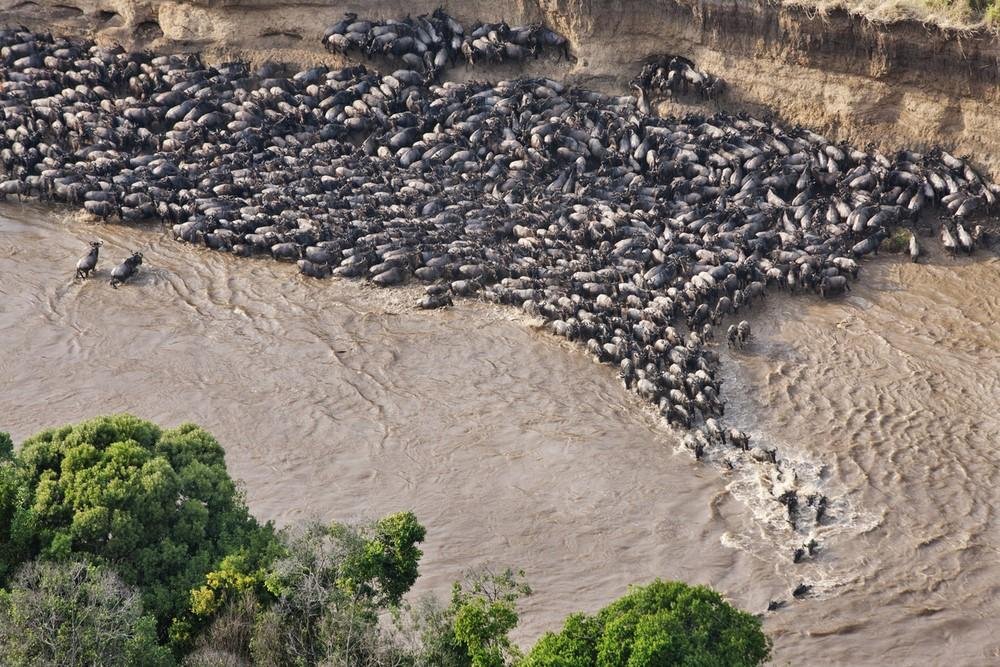
The crossings are the scene most people picture: thousands of wildebeest gathering on a steep bank, then plunging into a river where crocodiles wait. They happen on the Mara River, which runs through the Maasai Mara in Kenya and the far north of the Serengeti in Tanzania.
- When: July to October, with August usually the busiest month.
- How often: herds cross back and forth many times, not just once. A good guide watches where the herds gather and drives you to the most likely crossing point.
- Be patient: a herd can mass on the bank for hours and then turn away. Plan full-day game drives with a packed lunch so you don’t miss the moment.
- No guarantees: the rains set the timing each year. Early or late rain can shift the crossings by weeks, so give yourself at least 3 nights in the Mara or northern Serengeti.
Earlier in the season, from June to early July, the herds also cross the Grumeti River in the western Serengeti. These crossings are smaller but less crowded.
Calving season in Ndutu (late January – March)
Calving is the migration’s quieter, underrated chapter. From late January the herds gather on the short-grass plains around Ndutu, in the southern Serengeti and the Ngorongoro Conservation Area. Around 8,000 calves are born each day at the peak, roughly half a million over the season, and a calf can stand within minutes of birth.
All those newborns draw lions, cheetahs and hyenas, so this is one of the best times for predator sightings. The plains are green, the light is soft for photography, and there are far fewer vehicles than at the Mara River in August.
Calving pairs well with the Ngorongoro Crater and a few days on Zanzibar’s beaches.
Kenya or Tanzania: which side should you choose?
Both countries offer excellent migration viewing. The right choice depends on when you travel and how much time you have.
| Maasai Mara (Kenya) | Serengeti (Tanzania) | |
|---|---|---|
| Best months for the migration | July – October | All year, in different regions |
| Getting there | 5–6 hours by road or a 45-minute flight from Nairobi | Usually a flight or long drive from Arusha |
| Size | Compact, so the herds are easier to reach in a short stay | Very large, so more travel time between areas |
| Good for | Shorter trips of 3–4 days, first safaris | Longer trips, calving season, combining with Ngorongoro and Zanzibar |
| Combine with | Amboseli, Lake Nakuru, Diani beach | Ngorongoro Crater, Tarangire, Zanzibar |
Can’t decide? Do both. A combined Kenya and Tanzania safari lets you see the Maasai Mara and the Serengeti in one trip, with Amboseli’s views of Kilimanjaro thrown in.
Tips for planning your migration safari
- Book early. The best camps near the Mara River fill up 6–12 months ahead for July to September.
- Stay at least 3 nights in the migration area. Timing shifts with the rain, and extra days raise your chances.
- Choose a flexible operator. Local guides who track the herds daily can move you to where the action is.
- Consider shoulder months. June, late October and November can bring big herds, lower prices and fewer vehicles.
- Pack for dust and early mornings: neutral clothing, a warm layer, a hat, binoculars and a camera with a zoom lens.
Plan your Great Migration safari with Aardwolf
We’re a Nairobi-based, KATO-member safari company rated Excellent on TripAdvisor. Our guides know where the herds are each week, and we tailor every trip to your dates and budget.
- 8-Day Northern Serengeti Migration Safari
- 8-Day Kenya & Tanzania Safari: Mara, Serengeti & Amboseli
- 4-Day Maasai Mara: An Authentic Big Five Safari
Ready to see the migration? Plan your safari for a free tailor-made quote, or chat with us on WhatsApp: +254 721 300951.